
Think of your community as a garden where different ideas, initiatives, and people need the right conditions to flourish. Just as a gardener carefully balances soil nutrients, moisture, and sunlight, communities thrive when they create environments that are both stable enough to provide security and flexible enough to embrace change. This is the essence of a flexible growth medium: a community framework that adapts to new challenges while nurturing the roots of what already works.
Across Canada, forward-thinking communities are moving beyond rigid, one-size-fits-all approaches to development. They’re discovering that the most resilient neighborhoods and organizations don’t resist change or cling desperately to tradition. Instead, they cultivate conditions where innovation and stability coexist, where newcomers and long-time residents collaborate, and where local solutions emerge from genuine partnerships rather than top-down mandates.
The flexible growth medium approach recognizes a fundamental truth: communities are living systems that need room to breathe, experiment, and evolve. When we create spaces for diverse voices, support grassroots initiatives alongside established institutions, and remain open to adjusting our strategies based on what we learn, we build communities capable of weathering uncertainty and seizing unexpected opportunities.
This isn’t abstract theory. From urban centers reimagining public spaces to rural towns revitalizing local economies, Canadian communities are proving that flexibility isn’t weakness—it’s the foundation of lasting strength. The question isn’t whether your community needs a flexible growth medium, but how to cultivate one that reflects your unique strengths and aspirations.
What Makes a Growth Medium ‘Flexible’?
Think about a gardener preparing soil for a new garden. They’re not just piling dirt into a pot – they’re carefully mixing materials to create the perfect environment where plants can thrive. What makes that growing medium work isn’t rigidity, but flexibility. The same principle applies to communities.
In gardening, a flexible growth medium has specific qualities that allow plants to flourish in changing conditions. It’s porous enough to let roots breathe and expand. It adapts to different moisture levels without becoming waterlogged or bone-dry. It holds nutrients but releases them when needed, and it drains excess water while retaining what’s essential. These aren’t just nice-to-haves – they’re the foundation of healthy growth.
- Porosity
- In soil, tiny air pockets allow oxygen to reach roots and provide room for expansion. In communities, this translates to creating spaces for new ideas, welcoming diverse voices, and maintaining openness to change and innovation.
- Adaptability
- A good growing medium adjusts to varying conditions without losing its core structure. Communities need this same capacity to respond to economic shifts, demographic changes, and unexpected challenges while preserving their essential character and values.
- Nutrient-Rich Foundation
- Soil must contain essential elements that feed plants over time. Similarly, communities thrive when they cultivate resources like skills training, social networks, cultural programs, and educational opportunities that nourish residents’ potential.
- Effective Drainage
- Proper drainage prevents root rot by removing excess water while keeping enough moisture for growth. In community terms, this means creating systems that address problems efficiently without letting challenges stagnate or overwhelm local capacity.
When we translate these gardening principles into community development, we discover something powerful: the healthiest communities aren’t the most controlled or rigid ones. They’re the communities that build in flexibility from the start, creating conditions where people and initiatives can take root, adapt, and grow organically. Just as a gardener knows that different plants need slightly different conditions, community builders recognize that one-size-fits-all approaches rarely work. The magic happens when we create an environment rich enough to support diverse growth while maintaining the structure needed for everyone to flourish together.

The Core Ingredients of Community Flexibility
Inclusive Governance as Your Base Layer
Just as healthy soil needs the right pH balance and nutrient mix, thriving communities require governance structures that support growth without rigidity. Inclusive governance serves as your base layer—the foundation that holds everything together while allowing flexibility for change.
Think of participatory decision-making as creating multiple access points for community input, much like a growth medium with varied particle sizes that allows both water retention and drainage. When Toronto’s Parkdale neighbourhood redesigned their community spaces, they established rotating consultation circles that included renters, homeowners, newcomers, and long-time residents. This approach ensured stability in core values while adapting to evolving neighbourhood needs.
The beauty of inclusive governance lies in its dual nature. It provides consistent frameworks—regular meeting rhythms, transparent processes, clear communication channels—while remaining responsive to what community members actually need. Vancouver’s co-housing cooperatives demonstrate this perfectly, maintaining democratic decision-making structures that have endured for decades, yet flexibly adapting policies around everything from composting systems to guest accommodations based on resident feedback.
Building this base layer means investing time upfront to establish genuine participation pathways. It’s about creating space where diverse voices shape decisions together, ensuring your community’s growth medium stays nourishing for everyone it supports.

Partnership Networks as Nutrients
Just as nutrients feed a garden’s growth, partnership networks nourish community resilience and expansion. When organizations connect across sectors—nonprofits linking with businesses, schools collaborating with environmental groups, faith communities partnering with social enterprises—they create channels through which resources, knowledge, and energy flow freely.
Think of these connections as the mycelium network beneath a forest floor, quietly sharing nutrients between trees. In Guelph, Ontario, the Partnership for a Sustainable Community brings together over 50 organizations, from local government to grassroots groups, creating a rich exchange of ideas and resources that strengthens the entire ecosystem. When one organization faces a challenge, others provide support; when one discovers an innovative solution, the network helps it spread.
These partnerships work best when they’re diverse and reciprocal. A community food hub doesn’t just receive donations from local farms—it provides market access, shares harvest data, and connects farmers with schools seeking fresh produce. This two-way flow keeps everyone invested and thriving.
The beauty of partnership networks is their multiplier effect. Each new connection doesn’t just add value—it exponentially increases the community’s capacity to adapt, respond to challenges, and seize opportunities. Like nutrients cycling through healthy soil, these relationships create conditions where unexpected growth becomes possible.
Social Equity as the pH Balance
Just as pH balance determines whether a garden’s soil nurtures or stunts growth, social equity initiatives set the conditions for who thrives in our communities. When the growth medium is too acidic or alkaline, only certain plants survive. Similarly, when community resources and opportunities aren’t distributed fairly, only some residents can put down roots and flourish.
Equity work acts as the pH tester and balancer for our communities. It involves regularly checking who has access to opportunities, whose voices shape decisions, and which neighbourhoods receive investment. Organizations like the Toronto Community Benefits Network have demonstrated how intentional equity measures in development projects create pathways for marginalized residents to access jobs, training, and ownership opportunities that might otherwise bypass them entirely.
Creating an equitable growth medium means recognizing that equal doesn’t always mean fair. Some community members need additional supports to overcome historical barriers, much like gardeners add lime to acidic soil or sulfur to alkaline conditions. This might look like targeted funding for Indigenous-led initiatives, accessible programming for newcomers, or removing physical and social barriers for people with disabilities.
Vancouver’s Neighbourhood Small Grants program offers an inspiring model, deliberately prioritizing applications from equity-deserving groups and providing hands-on support throughout the process. By adjusting the conditions intentionally, they’ve ensured their community growth medium supports vibrant contributions from everyone, not just those with existing advantages. When we get the equity balance right, the entire community ecosystem becomes more resilient, creative, and productive.
Building Your Community’s Flexible Growth Medium
Creating a flexible growth medium in your community isn’t about following a rigid blueprint—it’s about nurturing the right conditions where innovation and adaptation can flourish naturally. Think of it like preparing soil in a garden: you’re not forcing specific outcomes, but rather creating an environment where diverse possibilities can take root and thrive.
The beauty of this approach is that it works with what you already have. Every community possesses unique assets, from engaged residents and local businesses to natural spaces and cultural traditions. The key is learning to leverage these strengths while remaining open to new opportunities and unexpected collaborations.
Here’s how your community can begin building its own flexible growth medium:
- Map your community’s assets and aspirations through inclusive conversations. Host listening sessions, surveys, or neighbourhood gatherings where everyone’s voice counts—not just the usual participants. You’ll often discover hidden talents, underutilized spaces, and shared dreams that haven’t had a platform yet.
- Identify your connectors and bridge-builders. Every community has people who naturally bring others together. Support these individuals by providing them with resources, recognition, and platforms to facilitate connections across different groups and sectors.
- Create low-barrier experiments rather than major commitments. Pilot projects, pop-up initiatives, and temporary installations let your community test ideas quickly and learn from what works. This might mean transforming a parking space into a parklet for a weekend or hosting a trial farmers market before committing to a permanent location.
- Build feedback loops into everything you do. After each initiative, gather input from participants and observers. What worked? What didn’t? What surprised you? This continuous learning process keeps your approach adaptive and responsive to real community needs.
- Establish partnerships that bridge traditional boundaries. The most resilient communities connect across sectors—linking environmental groups with business associations, schools with seniors’ centres, or arts organizations with urban planning committees. These cross-pollinations spark innovation and distribute both resources and risk.
What makes this approach powerful is its scalability. You don’t need a massive budget or formal authority to start. A neighbourhood association in Halifax began with simple monthly potlucks where residents shared skills—one person teaching composting, another offering language lessons. Within two years, this informal network had spawned three community gardens, a tool-sharing library, and a successful campaign to improve local transit access.
The flexible growth medium thrives on this kind of organic expansion. Each small success builds capacity and confidence, creating momentum for larger initiatives. Meanwhile, the relationships and trust you’re building become the foundation for tackling more complex challenges together—whether that’s climate adaptation, affordable housing, or economic development.
Remember, building a flexible growth medium is itself an adaptive process. Your community’s needs and opportunities will evolve, and your approach should evolve with them. Stay curious, celebrate small wins, and keep the conversation going.
Real Growth: Canadian Communities Getting It Right
Across Canada, communities are discovering that the secret to sustainable growth isn’t rigid master plans, but rather creating the right conditions for organic development. Let’s look at how three communities got it right.
In Halifax, Nova Scotia, the North End Community Hub transformed what could have been a top-down redevelopment into a collaborative success story. When the city identified several underutilized properties in the neighbourhood, instead of dictating their future, they created what locals now call their “community greenhouse.” The municipality provided basic infrastructure—clearing land, ensuring utilities, and establishing simple zoning guidelines—then stepped back to let residents shape the vision. Community groups, local businesses, and social enterprises submitted proposals, leading to an eclectic mix of affordable housing, co-working spaces, and urban gardens. The key? The city maintained flexibility in the zoning, allowing uses to shift as community needs evolved. Five years later, the area has become a vibrant hub that looks nothing like any planner’s original sketch, yet somehow exceeds everyone’s expectations.
Meanwhile, in Canmore, Alberta, the Bow Valley’s approach to managing tourism growth offers another powerful example. Recognizing that rigid tourism quotas would stifle the economy while unchecked growth would destroy what visitors came to see, the community developed what they call their “adaptive capacity framework.” Instead of setting fixed limits, they identified key indicators—trail congestion, wildlife corridor usage, resident satisfaction, and local employment rates. When indicators suggest strain, the community activates pre-agreed responses, from enhanced shuttle services to temporary parking restrictions. This flexible system allows tourism to ebb and flow naturally while protecting community wellbeing and environmental integrity.
In rural Saskatchewan, the Town of Watrous took a different approach to economic development. Rather than chasing specific industries with tax incentives, they invested in what Mayor John Smith calls “possibility infrastructure”—high-speed internet throughout the town, flexible commercial spaces that could accommodate everything from artisan workshops to tech startups, and a community fund that provides small grants without prescriptive requirements. Within three years, the town attracted an unexpected diversity of entrepreneurs, from remote software developers to specialty food producers, none of whom fit traditional rural economic development models.
These communities share a common thread: they created nutrient-rich conditions for growth without dictating exactly what should grow. They provided structure while embracing uncertainty, and the results speak for themselves.
When the Medium Gets Compacted: Common Challenges
Even the richest soil can become hard-packed over time, and the same holds true for our communities. When your flexible growth medium starts to compact, you’ll notice the signs: exciting new ideas struggle to take root, the same voices dominate every conversation, and collaboration feels more like pulling teeth than planting seeds together.
Three common obstacles tend to compress our community’s capacity for adaptation. First, resistance to change often stems from fear rather than stubbornness. People naturally worry about losing what’s working, even when they acknowledge that evolution is necessary. Second, resource scarcity creates a scarcity mindset where organizations hoard rather than share, competing instead of collaborating. Third, siloed structures keep different groups working in isolation, missing opportunities to cross-pollinate ideas and leverage collective strengths.
Watch for these warning signs that your community’s growth medium needs attention:
- The same small group makes all the decisions while others disengage
- New initiatives repeatedly stall in endless planning phases
- Organizations duplicate efforts rather than partnering on shared goals
- Community meetings feel stuck in patterns of complaint without problem-solving
- Younger or newer community members struggle to find meaningful roles
The good news? These challenges aren’t permanent conditions. Start by creating safe spaces for honest conversation about what’s not working. A community garden collective in Halifax transformed their struggling organization by hosting “failure feasts” where members shared lessons from projects that flopped, building trust and opening pathways for innovation.
Address resource scarcity through strategic sharing. Tool libraries, shared administrative services, and joint grant applications can stretch limited resources further while strengthening relationships. Breaking down silos requires intentional bridge-building. Invite representatives from different sectors to shadow each other’s work or co-design solutions to shared challenges. When organizations across Thunder Bay created cross-sector learning circles, they discovered complementary resources and launched three successful collaborative initiatives within a year.
The key is patience and persistence. Loosening compacted soil takes time, but every small step toward flexibility creates space for fresh growth.
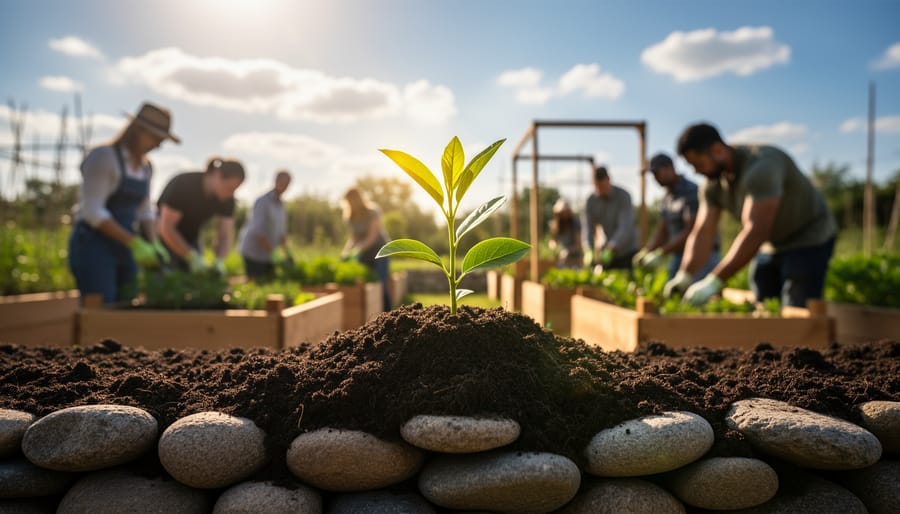
Creating a flexible growth medium for your community isn’t something that happens overnight. Just as a gardener carefully tends their soil season after season, building adaptive, resilient conditions for community development requires patience, commitment, and consistent nurturing. The good news? Every small action you take today contributes to creating stronger, more responsive conditions for tomorrow’s opportunities.
We’ve explored how communities across Canada are embracing flexibility through diverse networks, welcoming experimentation, and building adaptive capacity. From Vancouver’s collaborative housing initiatives to Guelph’s grassroots environmental projects, these success stories share a common thread: they started with people like you recognizing the need for change and taking that first brave step forward.
The beauty of this approach is that you don’t need to overhaul everything at once. Transformation happens through incremental shifts—one new partnership, one pilot project, one community conversation at a time. Each small improvement to your community’s “growing conditions” makes it easier for the next innovation to take root.
So here’s your invitation: take a moment to honestly assess your community’s current conditions. Where do you see rigidity that could benefit from more flexibility? What untapped connections might strengthen your local network? Then, choose just one small, concrete action you can take this week. Reach out to a potential partner. Attend a community meeting with fresh eyes. Share an idea you’ve been hesitant to voice.
Your community’s flexible growth medium begins with you, today.