
Quad Communities Development Corporation stands as one of Canada’s most effective community-driven organizations, transforming underserved neighborhoods through a model that places resident leadership, environmental stewardship, and economic equity at the center of every project. Founded in Toronto’s east end, the organization works across four interconnected communities to build affordable housing, support local businesses, and create green spaces that strengthen social ties while addressing climate resilience.
What sets Quad Communities apart is its refusal to impose solutions from above. Instead, the corporation partners with residents to identify priorities, secure funding, and implement projects that reflect the community’s lived experience. This approach has delivered tangible results: over 400 units of affordable housing developed since 2019, a thriving community land trust that keeps ownership local, and job training programs that have placed more than 600 residents in living-wage employment.
The organization’s environmental work goes beyond token gestures. Community gardens double as stormwater management systems. Energy retrofits cut costs for low-income households while reducing emissions. Every development project includes urban tree canopy expansion and habitat restoration, proving that sustainability and social equity advance together rather than competing for resources.
Quad Communities has also pioneered collaborative funding models that blend public grants, social finance, and community investment. This diversified approach allows the corporation to move quickly when opportunities arise and maintain independence from any single funding source.
For anyone working in community development or seeking examples of how grassroots organizations can drive meaningful change, Quad Communities Development Corporation offers a blueprint worth studying. Their success demonstrates that when communities lead their own transformation, the results are both more sustainable and more responsive to genuine local needs.
What Makes Quad Communities Development Corporation Different
Quad Communities Development Corporation stands apart in the Canadian community development landscape by centering relationships over transactions. While traditional development corporations often prioritize financial returns and rapid project completion, Quad Communities builds from the ground up, literally beginning with listening sessions, relationship-building, and deep community engagement before any construction plans take shape.
This relationship-first philosophy means projects take longer to launch but deliver outcomes that genuinely reflect what communities need. Instead of imposing predetermined development templates, Quad Communities spends months understanding the specific challenges, assets, and aspirations of each neighbourhood. Residents aren’t consulted as an afterthought, they’re co-creators from day one, shaping everything from building design to programming priorities.
The equity lens distinguishes every decision. Where conventional developers might maximize luxury units to boost profit margins, Quad Communities deliberately designs mixed-income housing that prevents displacement and preserves neighbourhood character. They track who benefits from their work, ensuring marginalized groups gain meaningful access to housing, employment opportunities, and community spaces rather than being pushed out by gentrification pressures.
Environmental stewardship is woven throughout rather than treated as an optional add-on. Quad Communities views green infrastructure and climate resilience as equity issues, recognizing that low-income communities and racialized neighbourhoods disproportionately suffer from environmental degradation and climate impacts. Their projects incorporate energy-efficient design, green spaces, and sustainable transportation connections as standard practice, not premium features.
Perhaps most distinctively, Quad Communities measures success differently. Traditional metrics like units built or dollars invested matter, but they also track social cohesion, resident satisfaction, local hiring outcomes, and neighbourhood stability over time. They’re willing to sacrifice speed and maximum profit for lasting community benefit, a model that challenges standard development industry practices but creates neighbourhoods where people genuinely want to live, not just properties that generate returns.
This patient, equity-centered approach requires different funding models, longer timelines, and deeper partnerships. But it produces something conventional development rarely achieves: communities that actually work for the people who live there.
Building Equity Into Every Development Decision
Inclusive Governance in Action
Quad Communities doesn’t just consult community members after development plans are drawn, they invite residents into the room where decisions are made. Their governance model reserves seats at the table for people whose voices traditionally get sidelined: tenants in social housing, newcomers navigating language barriers, Indigenous community leaders, and disability advocates who understand accessibility needs beyond code minimums.
At quarterly planning sessions across their projects, residents vote on priorities like which amenities get built first or how shared spaces should function. One Toronto neighbourhood recently chose a commercial kitchen over additional parking because newcomer families wanted space to run catering businesses. That decision came directly from tenant input, not a developer’s assumption about what communities need.
The corporation trains community members in planning fundamentals, reading site plans, understanding zoning language, evaluating budget trade-offs, so participation means genuine influence rather than rubber-stamping predetermined choices. They compensate residents for meeting time with honorariums and childcare, recognizing that meaningful engagement requires removing barriers, not just opening doors.
When conflicts arise between different groups’ priorities, Quad Communities uses facilitated dialogue sessions where a Somali elder and a skateboarding teenager can both explain why certain green space matters to them. Solutions emerge from understanding competing needs, not overriding them. This process takes longer than top-down decisions, but developments stick because they reflect what people actually want from their neighbourhood.
Addressing Housing Affordability and Access
Quad Communities tackles housing affordability through a three-pronged approach: preserving existing affordable stock, creating new below-market units, and designing mixed-income developments that avoid economic segregation. Rather than building separate “affordable” complexes that concentrate poverty, they integrate subsidized units into market-rate buildings, ensuring every resident accesses the same amenities and quality construction.
Their strategy starts with land acquisition in gentrifying neighbourhoods before prices spike. By securing sites early, they lock in lower costs and can offer units at 30-40% below market rent without ongoing subsidies. They also partner with municipalities to access surplus public land, reducing the biggest barrier to affordable development. These partnerships align with affordable housing development guidance that emphasizes public-private collaboration.
Key initiatives include:
- Rent-geared-to-income units where housing costs never exceed 30% of household income
- Shared equity homeownership programs that help first-time buyers build wealth while keeping units affordable for future purchasers
- Multigenerational housing designs that accommodate extended families and reduce per-person costs
- Transit-oriented developments that cut transportation expenses, the second-largest household cost after housing
Quad Communities also maintains affordability long-term through land trusts that separate building ownership from land ownership. Residents own their homes but lease the land beneath them, dramatically reducing purchase prices. When owners sell, resale formulas ensure the next buyer gets the same affordability benefit, preventing windfall profits that would push units back to market rates.
Environmental Sustainability Meets Community Growth
When Quad Communities Development Corporation plans a new project, they start with a question most developers never ask: how can this development give back to the environment, not just take from it? This fundamental shift in thinking drives their approach to creating neighbourhoods that grow stronger as they grow greener.
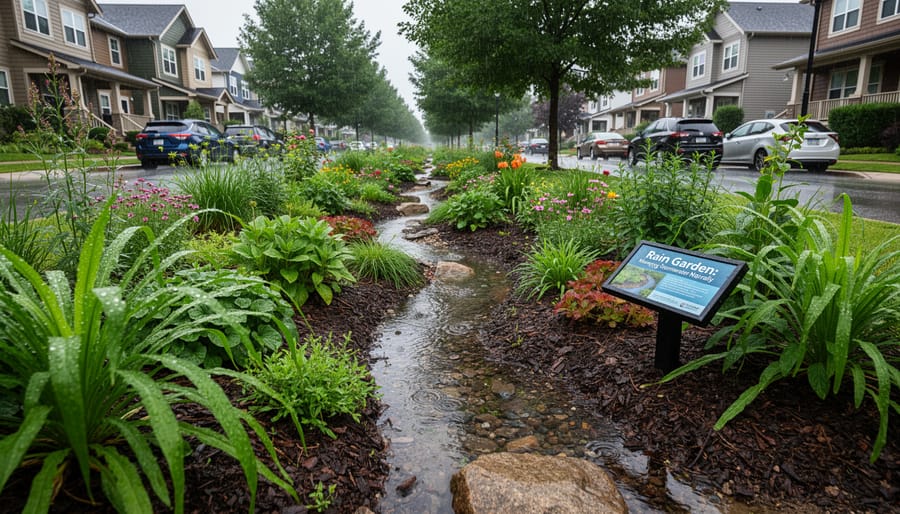
Their projects weave green infrastructure directly into community design rather than treating it as an afterthought. Bioswales replace traditional storm drains, filtering rainwater naturally while creating green corridors that connect neighbourhoods. Community gardens occupy former vacant lots, producing fresh food while reducing urban heat islands. Native plant landscaping supports local pollinators and requires minimal water once established, cutting maintenance costs while rebuilding ecosystem health.
The buildings themselves reflect this same integration. Quad Communities prioritizes energy-efficient construction methods that slash heating and cooling costs for residents, making affordability more sustainable over time. Solar panels on community centres generate clean power while demonstrating renewable technology to residents. High-efficiency building envelopes keep homes comfortable year-round without fossil fuel dependence. These aren’t luxury green features, they’re practical choices that reduce living expenses for families while cutting carbon emissions.
Climate resilience shapes every design decision. In flood-prone areas, they elevate critical infrastructure and create permeable surfaces that absorb heavy rainfall instead of overwhelming sewers. Heat-resistant materials and strategic tree planting protect vulnerable residents during extreme weather events. Community cooling centres double as gathering spaces, serving dual purposes that maximize both social connection and climate adaptation.
What sets Quad Communities apart is how they make environmental sustainability visible and accessible. Educational signage explains how rain gardens work. Community workshops teach residents about composting and energy conservation. Youth programs connect kids to nature through hands-on habitat restoration projects. This transparency transforms residents from passive occupants into active environmental stewards who understand why these features matter.
The result? Neighbourhoods where environmental health and community vitality reinforce each other. Lower energy bills free up household budgets. Cleaner air and water improve resident health. Green spaces become gathering spots that strengthen social bonds. Quad Communities proves that environmental responsibility isn’t a trade-off against community development, it’s the foundation for development that truly lasts.
Partnership Power: Connecting Organizations for Stronger Communities
The Fellowship Network Approach
At the heart of Quad Communities’ partnership strategy sits the Fellowship Network, a collaborative model that transforms how organizations work together across Canadian communities. Rather than operating in silos, member groups share insights, pool resources, and tackle common challenges as a unified force.
The Fellowship Network functions as both a learning community and an action platform. Organizations exchange proven strategies for affordable housing development, environmental initiatives, and inclusive governance. When one group discovers an effective approach to resident engagement or secures sustainable funding, that knowledge flows quickly to others facing similar obstacles.
This structure also enables coordinated responses to systemic issues. If housing affordability pressures affect multiple neighbourhoods simultaneously, network members can advocate together for policy changes while implementing complementary local solutions. The collective bargaining power and shared expertise amplify what any single organization could achieve alone.
Resource pooling extends beyond money. Members share technical expertise, staffing capacity during peak project phases, and connections to funding sources. A small community group gains access to the professional development support and planning tools that larger organizations possess, leveling the playing field and accelerating meaningful change across diverse communities.
Local Success Stories: Communities Transformed
The impact of Quad Communities Development Corporation’s work shows up most vividly in the neighbourhoods they’ve helped reshape across Canada. These success stories demonstrate how intentional, equity-focused development creates lasting change for residents.
In East Hamilton, Ontario, a former industrial corridor sat largely vacant for years before Quad Communities partnered with local groups to reimagine the space. Today, that same area houses 180 mixed-income residential units alongside community gardens, a shared workshop space for local artisans, and a neighbourhood hub that hosts ESL classes and skills training programs. Property manager Rashida Chen notes that 68% of residents now participate regularly in community programs, and the area has attracted twelve small businesses owned by neighbourhood residents. “What changed wasn’t just the buildings,” she explains. “The whole social fabric shifted when people had affordable spaces to live, work, and connect.”
Vancouver’s Grandview-Woodland neighbourhood saw similar transformation through a Quad Communities initiative focused on preserving affordability while improving infrastructure. By working directly with long-time residents facing displacement pressure, they developed a cooperative housing model that kept 240 families in their community. The project incorporated rooftop solar arrays, rainwater collection systems, and native plant landscaping that reduced building operating costs by 31% while creating green spaces residents actually use. Local youth employment in the construction phase reached 22%, providing skills training that continued benefiting young people long after project completion.
In Winnipeg’s North End, Quad Communities tackled food security alongside housing. Their multi-phase development included not just 95 affordable units but also a community kitchen, a year-round farmers market space, and urban agriculture plots. Within two years, residents reported 40% better access to fresh produce, and the community kitchen became a gathering place where newcomers and established residents share meals and cultural traditions. Resident Gloria Sinclair, who helped design the kitchen space, says it changed how neighbours relate to each other: “We weren’t just living side by side anymore, we were building something together.”
These projects share common threads: residents involved from planning through implementation, designs that address multiple community needs simultaneously, and infrastructure choices that reduce environmental impact while improving daily life. The results aren’t just physical improvements, they’re stronger social networks, better economic opportunities, and communities where people choose to stay.
Getting Involved: How Your Community Can Connect
Whether you’re a local organizer, a nonprofit leader, or a resident who wants to see equity-driven development in your area, connecting with Quad Communities Development Corporation’s work offers multiple entry points. The organization welcomes engagement from communities at various stages, from early exploration to active partnership, and their collaborative approach makes their model accessible to others.
If your community or organization wants to explore how Quad Communities’ principles might apply in your context, start with these concrete steps:
- Research their published case studies and project documentation to understand which aspects of their model align with your community’s needs and capacity.
- Attend community development forums or workshops where Quad Communities representatives share insights and methodologies, these events often provide networking opportunities with similar organizations.
- Reach out directly through their website or professional networks to request an informational conversation about their approach and potential ways to collaborate or learn.
- Identify local partners in your area who share equity and sustainability values, as collaborative networks strengthen any community development initiative.
- Pilot small-scale inclusive practices in your current work, like participatory budgeting or resident advisory committees, to build organizational readiness for broader equity-focused approaches.
Beyond formal partnerships, you can apply Quad Communities’ core principles within your existing projects. Start incorporating equity audits into development decisions, ensuring diverse representation in planning conversations, and prioritizing environmental sustainability alongside community needs. Many communities begin by adapting one element, such as inclusive governance structures or affordable housing strategies, before expanding to comprehensive approaches.
Local organizations can also benefit from joining broader networks like the Fellowship Network, where knowledge exchange happens informally. These connections create opportunities to learn from peers facing similar challenges and discover innovative solutions being tested across Canadian neighbourhoods. The path to equitable community development doesn’t require reinventing the wheel, it means adapting proven approaches to your unique local context.
The work of Quad Communities Development Corporation demonstrates what becomes possible when community development centres people rather than just buildings. Their equity-focused model shows that creating neighbourhoods where everyone belongs requires intentional design, genuine partnership, and sustained commitment to inclusion at every stage.
Across Canadian communities, the traditional approach to development often leaves gaps, affordable housing that remains out of reach, green spaces that serve only some residents, decision-making that excludes the voices most affected. Quad Communities challenges this pattern by embedding equity into governance structures, prioritizing environmental sustainability alongside social goals, and building the collaborative networks that amplify impact beyond what any single organization can achieve alone.
The success stories emerging from their work prove this approach delivers real results. Residents gain stable housing. Marginalized communities find their perspectives shaping neighbourhood futures. Local organizations access resources and knowledge through networks like the Fellowship that strengthen collective capacity. These outcomes ripple outward, creating models other communities can adapt and build upon.
Looking ahead, the demand for equitable community development will only intensify as Canadian cities grow and climate pressures mount. The principles Quad Communities champions, inclusive governance, affordable access, environmental responsibility, powerful partnerships, offer a blueprint for meeting these challenges. Their work reminds us that thriving neighbourhoods don’t happen by accident. They result from deliberate choices to prioritize people, embrace sustainability, and recognize that community strength grows from shared ownership of our collective future.
The path forward runs through organizations willing to do this essential work, and communities ready to demand development that truly serves everyone.