
K communities are networks of people, organizations, and institutions connected through knowledge-sharing, collaboration, and mutual support to drive meaningful change in their neighborhoods. These intentional networks prioritize equity by ensuring everyone has access to decision-making, resources, and opportunities, transforming how communities tackle challenges from affordable housing to climate action. At their core, k communities recognize that sustainable development happens when diverse voices work together, sharing what they know and learning from one another.
The concept matters now more than ever. Across Canada in 2026, communities face complex, interconnected challenges that no single organization can solve alone. Traditional top-down approaches often leave gaps, missing the lived expertise of residents and failing to address root causes of inequality. K communities flip this model by building horizontal connections that pool knowledge, strengthen relationships, and distribute power more equitably.
What makes these networks powerful isn’t just collaboration for its own sake. K communities create structured pathways for knowledge to flow between residents, nonprofits, businesses, and local government. A tenant advocacy group shares housing data with city planners. A community garden teaches sustainable agriculture while connecting newcomers with longtime residents. Youth organizations partner with seniors to document neighborhood history and envision its future together.
Canadian communities already demonstrating this approach show tangible results: reduced service gaps, increased civic participation, and solutions that actually reflect community needs. The shift requires intentional relationship-building, transparent communication, and a commitment to centering voices typically excluded from planning tables. When knowledge becomes a shared resource rather than a guarded commodity, communities develop the collective capacity to shape their own futures with greater resilience and imagination.
What Makes a Community a ‘K Community’?
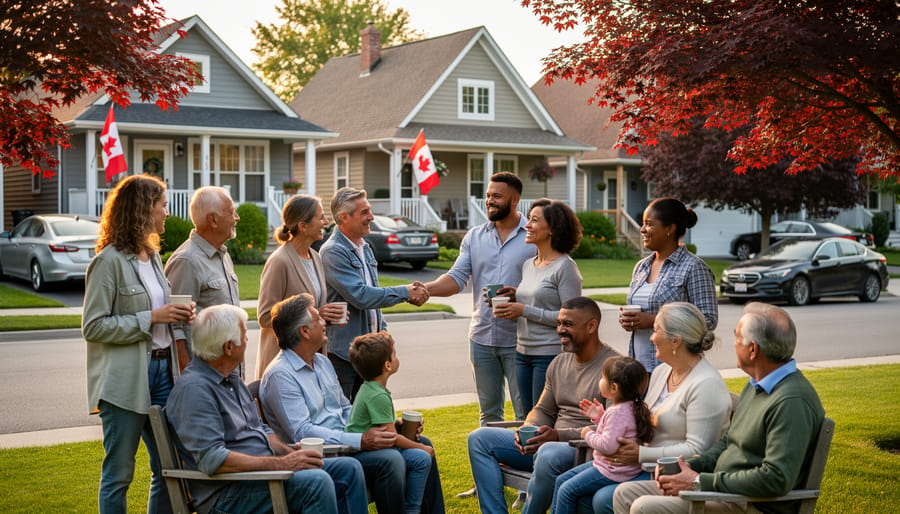
The term “k communities” emerged from urban sociology research in the 1990s, where researchers noticed that neighborhoods with higher rates of what they called “kinship-like connections” demonstrated markedly better social outcomes. The “k” stood for the quality of knowing your neighbors well enough to borrow an egg, ask for help moving furniture, or trust them to watch your kids for an hour. These weren’t necessarily blood relations but functioned with similar reliability and reciprocity.
What distinguishes k communities from other neighborhoods isn’t complex. It’s the difference between living near people and living with them. In a k community, residents recognize each other by name, not just by sight. They notice when someone’s been away or when a neighbor needs support. This recognition creates a foundation of trust that ripples through everything from crime prevention to mental health outcomes.
At their core, k communities share several defining characteristics:
- Social Cohesion
- Residents feel connected to their neighbors through regular interaction, shared experiences, and a sense of collective identity. This goes beyond politeness to genuine concern for each other’s wellbeing.
- Neighbor Recognition
- People know who lives on their street, recognize faces, and understand the basic rhythms of their neighbors’ lives. This awareness creates informal networks of mutual care and accountability.
- Shared Resources
- Communities actively pool tools, skills, time, and knowledge rather than duplicating ownership. This might look like shared garden equipment, skill swaps, or informal childcare exchanges.
- Collective Efficacy
- Residents believe they can work together to solve local problems and improve their neighborhood. This shared confidence translates into action when challenges arise.
For contemporary community development in Canada, k communities offer a counterweight to increasing isolation and digital disconnection. As urban density rises and traditional gathering spaces disappear, the k community framework provides a measurable goal: build neighborhoods where people know enough about each other to care and act. The relevance isn’t nostalgic. It’s practical evidence that stronger social infrastructure creates healthier, safer, more equitable places to live.
The Connection Between K Communities and Social Equity
Breaking Down Barriers Through Belonging
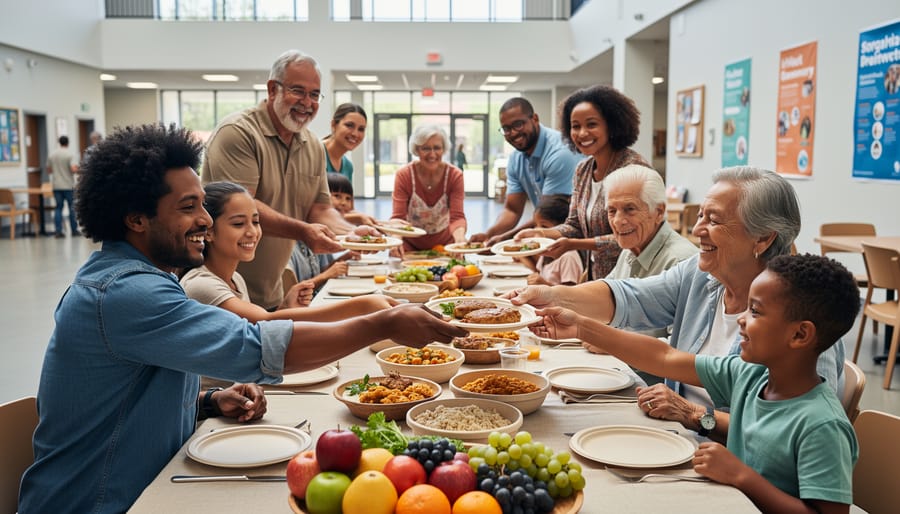
When you’re new to a neighborhood, whether you’ve just immigrated to Canada, relocated from a reserve, or simply moved across town, the difference between a k community and a collection of strangers becomes immediately clear. In tight-knit neighborhoods, informal introductions happen at the mailbox, community gardens become natural meeting points, and neighbors share information about local services, job opportunities, and school registration without being asked. This organic knowledge transfer matters enormously for people navigating unfamiliar systems.
K communities excel at reshaping equity because they operate on relationship currency rather than formal credentials. A newcomer who doesn’t yet have Canadian work experience can tap into the neighborhood network for references, informal mentorship, or side gigs that build both skills and confidence. Indigenous families moving to urban centers often find that k communities with active Elders and cultural practitioners provide crucial bridges between traditional practices and city life.
The trust built through repeated small interactions, borrowing tools, watching each other’s kids, sharing rides, creates a foundation for bigger asks. When someone needs help navigating healthcare, understanding tenant rights, or accessing food security programs, they’re more likely to ask a neighbor they already know than to cold-call an agency. These pathways don’t replace formal support systems, but they make them navigable and less intimidating for people who’ve historically been excluded or underserved.
Economic Resilience in Connected Neighborhoods
When neighbors know and trust each other, they create informal safety nets that cushion financial shocks. In k communities, a broken appliance doesn’t mean an emergency credit card charge, it means texting the neighbor who fixes washing machines or borrowing tools from the family down the street. This everyday resource sharing adds up to real savings that keep money circulating locally rather than flowing to big-box retailers.
Skills become community currency in these neighborhoods. The accountant who helps with tax returns receives homemade preserves in return. The retired carpenter mentors teens learning woodworking while parents provide rides to medical appointments for elderly neighbors. These exchanges don’t show up in GDP calculations, but they strengthen household budgets and build the kind of mutual obligation that makes communities resilient during economic downturns.
The economic impact extends beyond individual transactions. K communities become proving grounds for micro-enterprises and side hustles that might never launch without that initial neighborhood support base. The home baker testing recipes finds her first customers at the community center. The handyman builds his client list through word-of-mouth recommendations from neighbors who’ve seen his work firsthand. This grassroots economic activity creates jobs that can’t be outsourced and keeps wealth within the community where it multiplies through repeated local spending.
Building K Communities: Strategies That Work in Canadian Contexts
Creating Spaces for Regular Connection
Trust grows where people bump into each other regularly. That’s why the physical design of a neighborhood matters as much as its social programs. A well-placed bench, a community garden tucked between apartment buildings, or a rec center open for drop-in hours creates what urban planners call “third places”, spots that aren’t home or work, where casual hellos turn into real conversations over weeks and months.
Research confirms that urban green space fosters cohesion by giving neighbors a reason to linger rather than rush past. Think of the community rink where parents chat during skating lessons, or the shared tool shed that becomes a Saturday morning gathering spot. These spaces work because they’re easy to access, welcoming to everyone, and built for repeat visits, not one-off events.
The magic isn’t in grand architecture. It’s in consistency. When the same faces show up at the same pocket park or neighborhood kitchen week after week, you move from strangers to familiar faces to friends who’ll water your plants when you’re away.
Leveraging Partnerships and Local Organizations
Building k communities rarely happens in isolation. The strongest connections form when municipalities provide infrastructure, nonprofits offer programming expertise, and grassroots groups bring lived experience to the table. This three-way partnership creates the conditions for neighbors to actually know each other.
In Halifax, a collaboration between the city’s recreation department, a local housing nonprofit, and a resident-led garden collective turned an underused park into a weekly gathering space. The city maintained the grounds, the nonprofit secured funding for events, and residents organized potlucks and skill shares. Within eighteen months, 200 households who’d never spoken became a network that shares childcare, tools, and emergency support.
These partnerships work because each player contributes what they do best. Municipalities can waive permits and dedicate public space. Nonprofits bring community development methods and grant-writing capacity. Grassroots groups ensure initiatives reflect what neighbors actually want, not what outsiders assume they need.
The key is keeping decision-making power close to residents. Partnerships accelerate k communities when they enable neighbor-to-neighbor connection, not replace it with top-down programming.
Digital Tools That Strengthen (Not Replace) Face-to-Face Bonds
Technology works best when it brings neighbors together in person, not when it keeps them staring at screens. The right digital tools can help coordinate meetups, share resources, and spark conversations that lead to real relationships, but only when communities use them as a bridge, not a destination.
Apps like Nextdoor or local Facebook groups become k community accelerators when residents use them to organize tool swaps, coordinate street cleanups, or find someone to water plants while they’re away. The magic happens when the online exchange becomes “I’ll drop that off tomorrow” rather than endless comment threads. Think of these platforms as modern bulletin boards: they work when they prompt action, not when they become another scroll.
Communities strengthening local bonds are using:
- Shared calendars for block parties, skill shares, and seasonal gatherings
- Group chats for quick asks like “Anyone have a ladder I can borrow?”
- Buy-nothing groups that facilitate porch pickups and face-to-face handoffs
- Volunteer sign-up sheets for community gardens or neighborhood watch rotations
- Photo-sharing spaces celebrating local events and familiar faces
The rule of thumb: if your digital tool increases how often you see neighbors in real life, it’s serving k community goals. If it replaces those encounters with virtual ones, it’s pulling in the wrong direction. Edmonton’s Ritchie neighborhood, for instance, uses a simple WhatsApp group not for endless chatting but to coordinate their monthly potlucks and winter snow-clearing crews, the app gets people outside together, then gets out of the way.
K Communities and Environmental Sustainability
Collective Action on Climate Challenges

When neighbors know each other well enough to share garden tools and trade recipes, they’re often just a few conversations away from tackling bigger challenges together. Climate action flourishes in k communities because trust is already established, people move from “What can I do alone?” to “What can we accomplish together?”
Shared composting systems offer a perfect entry point. In Canadian neighbourhoods where residents know their immediate circle, backyard composters often expand into communal bins that serve multiple households. This reduces individual maintenance while diverting more organic waste from landfills. Some k communities have negotiated with municipalities to place larger community composting stations in parks or shared green spaces, turning what might feel like a chore into a regular social interaction point.
Community energy projects gain momentum when neighbors coordinate their efforts. Groups of connected households pool resources to install shared solar arrays on apartment buildings or negotiate bulk purchasing for home energy retrofits. In rural k communities, residents collaborate on biomass heating systems that serve multiple properties, sharing both the infrastructure costs and the ongoing management responsibilities.
Local food systems transform when strong social networks support them. K communities establish successful community gardens not just as growing spaces but as knowledge-sharing hubs where experienced gardeners mentor newcomers. Seed swaps, harvest exchanges, and collective purchasing from regional farms all depend on the trust and communication patterns that define these tight-knit neighborhoods. The result is greater food security alongside reduced transportation emissions.
The Sharing Economy Starts at Home
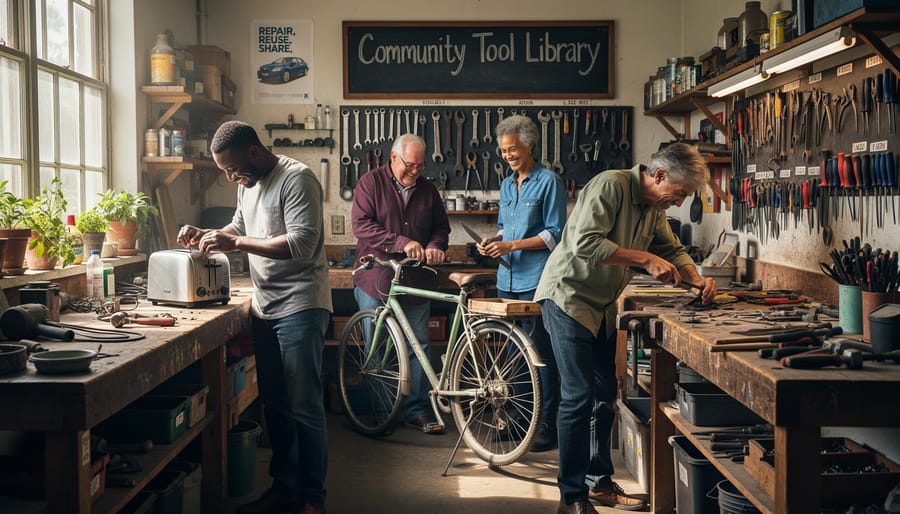
Tool libraries, car-sharing cooperatives, and repair cafes flourish in k communities because trust and proximity eliminate the friction that usually stops people from sharing. When you know your neighbors, borrowing a ladder or a lawn mower becomes a quick conversation, not a complicated transaction. This hyperlocal sharing dramatically cuts consumption, fewer households need to own items they use twice a year, which means less manufacturing demand, less storage waste, and lower carbon emissions per capita.
Repair cafes, where neighbors gather to fix broken appliances and clothing together, thrive on the same principle. They depend on volunteers who show up reliably and participants who return the favor, relationships that form naturally in tight-knit neighborhoods. Vancouver’s Repair Café movement has grown precisely in areas where residents already knew each other through community gardens and block parties.
Car shares work similarly. Formal programs like Modo in Victoria operate more successfully in neighborhoods with existing social cohesion, but many k communities create informal arrangements, shared vehicles managed through group chats, with maintenance divided among families who’ve built mutual accountability. These systems only function where people trust each other to refuel, report damage, and honor booking schedules, infrastructure that k communities provide organically.
Real Canadian K Communities Making a Difference
Across Canada, neighborhoods are proving that tight-knit communities can address real challenges and create lasting change. In Toronto’s Parkdale neighborhood, residents have built a network of mutual aid that started with a simple Facebook group during the pandemic. Today, that connection has evolved into coordinated responses to housing insecurity, regular skill-shares where neighbors teach everything from home repair to tax preparation, and a thriving community fridge program that redistributes thousands of pounds of food annually while bringing people together around shared meals.
The West End Food Co-op in Vancouver demonstrates how resource sharing creates both environmental and social impact. Members collectively purchase bulk organic produce, splitting costs and reducing packaging waste. What began as a purchasing club has grown into a neighborhood institution where people swap gardening tips, coordinate composting pickups, and mentor newcomers through inclusive participation in decision-making processes. The co-op has cut member food costs by roughly thirty percent while diverting several tons of packaging from landfills each year.
In rural Nova Scotia, the community of Whycocomagh has revitalized its Mi’kmaq cultural center through collective effort, with elders teaching language classes and residents of all backgrounds volunteering to maintain the space and organize events. This hub has become the heart of connection across the small town, bridging Indigenous and non-Indigenous residents while creating economic opportunities through cultural tourism that benefits local families.
These examples share common threads: they started with people who knew each other’s names, they built trust through consistent small interactions, and they tackled specific local needs rather than abstract goals.
Building a k community doesn’t happen in a week or even a month. It unfolds through small, repeated gestures, learning your neighbor’s name, showing up to a community meeting, offering help when someone needs it. These everyday actions accumulate into something much larger: a neighborhood where people genuinely know and look out for each other.
The communities profiled throughout this article didn’t start with grand plans or substantial funding. They began with individuals who decided connection mattered more than convenience, who chose to say hello instead of rushing past, who organized that first potluck or tool share despite uncertainty about who would show up.
You don’t need to transform your entire street tomorrow. Start with one neighbor. Attend one local event. Join one community group. These modest beginnings create ripples that extend far beyond what you can see initially. When you strengthen one connection, you make it easier for the next person to do the same.
K communities represent equity in action not as an abstract ideal, but as the lived experience of belonging, mutual support, and shared resources. The question isn’t whether your neighborhood can become one. It’s whether you’re ready to take that first small step toward making it happen.